What’s on your “running” playlist?

I suspect that most triathletes have a playlist like mine. “Running” is what I’ve chosen to label it but it is the default playlist that I use when going out for a run or strength training at the gym. It’s got 60 songs but there are really about a dozen songs that have a “story” behind why they ended up on my playlist. As a result I think it’s kind of an eclectic combination of songs. Some of them fit for a running playlist while others are only there because of circumstance.

Here they are:

“American Woman” by Lenny Kravitz: I heard this song at mile 139.5 out of 140.6 at Ironman Lake Placid. Someone had a stereo system set up on their front lawn on Mirror Lake Drive and it will forever be in my head as the song I heard on my last mile of my first Ironman.

“Best of You” by the Foo Fighters: This song seems to be a favorite of Keith Jordan of Endorfun Sports. I think it has only been at his races that I’ve heard it. One of the great things about Keith’s races is there speakers he has set up along the run course. The first time I heard this one was at the Mooseman 1/2 Ironman going up the first hill just after the road peels away from Newfound Lake.

“Beautiful Day” by U2: If you’ve been to an Ironman Lake Placid race you probably know where this one comes from. I’ve been to the race for the past four years straight (once as a competitor) and it is the last song played before the cannon goes off before the swim start. My heart races just thinking about being in Mirror Lake with 2000 other competitors about to begin the day.

“Candles” and “Alive” by Dirty Vegas: Janus is a sponsor of Ironman and I’m in the process of using their Charity Challenge program for a 2nd time to raise money for Bretton Woods Adaptive. After my first Ironman in 2006 Janus produced a video with footage from the race that used both of these songs in it. They handed it out at the awards banquet after the race where I received 2nd place……definitely not for speed for for the amount of money raised. I probably watched that video a hundred times in the first month after the race.

“Sugar, We’re Goin Down” by Fall Out Boy: The three years I’ve been at Ironman Lake Placid while not racing, I’ve volunteered in various parts of the race. The past two times my son came with me and we volunteered together – an awesome experience. I don’t know if he’ll ever want to do an Ironman but I’m glad he’s been able to attend if for no other reason than to be inspired by what is possible when you set a goal. This last year we spent the ENTIRE day in a pouring down rainstorm, four hours of which were handing out supplies to racers at one of the aid stations. While waiting for some GSTC finishers that year, this song came on and it reminds me of the day in the rain I spent with my son. I wouldn’t trade it for anything.

There are definitely a few others but these are the highlights. What songs do you have on your “running” playlist and what’s the story?

Triathlon’s hidden expenses

Triathlon is not a cheap sport. Even if you stick to shorter sprint distance races, and your starting from scratch, by the time you buy a bike, running shoes, training and racing gear and a pool pass you’ve likely eclipsed the $1,500 to $2,000 mark. Oh yeah, you still haven’t registered for the race which will run another $50 – $100.

If you decide to jump up to the 1/2 Ironman or Ironman distance then you end up in a whole other league of expenses, many of which we never consider before signing up.
There are the direct fees like race entry.  Just for the privilege of suffering for 12 – 14 hours at Ironman it will cost you $525 to register. Though I’m telling myself this is a bargain because if I break it down by the hour it’s only about $40/hour based on my finish time (if I go even slower the bargain gets even better!).  Compare that to a sprint race I did last year that cost $80 to register and I was done in a little over an hour – that’s twice the cost per hour! That’s how I justify racing Ironman anyway.
Here are a few examples of the hidden expenses that I’ve experienced:
  • Food – Last week my training hours hit 12.5 which works out to about 10,000 calories. I’m not a small guy and my basal metabolic rate is about 1,900 calories per day, or another 13,300 for the week bringing the week’s total to 23,300 calories I need to replenish. Thankfully for my wallet, I’m also trying to drop a few pounds before race day so maybe I only replenished 20,000 calories that week.  Just to make sure I stay healthy with the increased workload I also take supplements from Hammer Nutrition which are not cheap.
  • Pool fees – At only $5 to $10 per visit it doesn’t seem to be a big deal. Until you multiply that times 3 – 4 swim workouts a week.
  • Laundry – Especially over the winter this one can really add up.  Today is a typical example of 1 day’s laundry.  This morning I ran, and it was cold, really cold.  I wore 1 pair of socks, a bottom base layer, running pants, a long sleeve top base layer, wind vest, long sleeve top layer, balaclava, a hat, a pair of mittens and a pair of gloves. this was followed by a swim at the pool later in the day which only produced a swim suit and towel.  Two a day workouts are not unusual for most of the week so needless to say we do a whole lot of laundry throughout the week (thanks Amy!)
  • Travel – Conveniently for the Ironman race in Lake Placid all of the hotels double their rates and require a four night minimum, so, you know that doesn’t help any. They’ll be one to two training trips this spring to Lake Placid.  Thankfully I know several people who are also racing and we’ll be able to carpool and split a hotel room. I’m just praying that gas prices stay relatively low!

I’m afraid to go into any more examples for fear of talking myself out of doing triathlon any longer.

What expenses am I missing?
Photo credit: Jenn_jenn

Rigid vs. Flexible

I recently received the next training block from Suzan, my coach. While plugging the workouts into my schedule for the next four weeks it became quickly apparent that it is going to be a challenging month. It’s not only the physical challenge of the training volume at 10 – 12 hours per week but the prospect at trying to fit it all in with the rest of life.

Over the next four weeks my Son turns 11 and the major fundraiser for Bretton Woods Adaptive is taking place in addition to a busy work schedule. This scheduling exercise of training for an Ironman while also having a family and a job has highlighted the need to have a balance between a rigid disipline to do the training and flexibility to fit it in whenever possible.

The Problem
For example, in two weeks I’ll be participating at the BWA Blast, an all day downhill skiing event which is the major annual fundraiser for the charity I’m supporting through the Janus Charity Challenge. I feel a need to be there. Scheduled for the same day is a 2-hour bike followed by a 20-minute run with a 1 hour 45 minute run the next day. I’m at a stage of my training cycle when building an aerobic base is critical for the next stage in training. Missing these workouts would really not be good.

Normally I would do the bike outside in the middle of the day on Saturday when it’s warm enough and do the long run on Sunday morning. I definitely can’t fit the bike in on the day of the fundraiser and I’d rather not run for almost 2 hours the morning after skiing all day.

The Solution
My plan at this point is to ride on Sunday and get up early on Monday to fit the run in before work. Not an ideal scenario but it is the reality of my balance between being rigid and flexible.

The fate of radio advertising?

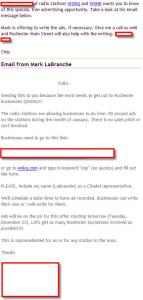
A friend recently sent me the ad you see below.  It was an advertising promotion for a radio station in my area in which they were giving away free 30 second spots to area businesses.  Is this the fate of radio advertising, and for that matter, other interruption based advertising mediums such as television, cold calling, etc?  

radio-ad

I see the overall concept I think this radio station was going for – use the January advertising campaign as a loss leader to interest people into then paying for radio advertising in the future.  There are some major issues I see with the concept:

  • Radio ads are not easily trackable.  One of radio’s biggest deficiencies is the lack of being able to track it effectively. Sure you can use a specific phone number to respond to or website URL but it still doesn’t effectively measure the impact of the campaign. It is too prone to a prospect forgetting the number or just going to the company’s main website. This begs the question, how do you show the value in buying future advertising if you can’t track it’s effectiveness?
  • It’s a form of interruption advertising that is becoming less effective. Radio ads rely on catching a prospect at the exact right time that they are interested in your product or service.  If your timing is off, they’ll switch the station (the same problem television advertising has).
  • Who’s listening to the radio? Chris Anderson in his Long Tail blog cited a statistic from the Future of Music Coalition that radio listenership was at a 27 year low.  This was almost four years ago – who knows where that number is now.  This shouldn’t be a surprise with the rise in popularity of satellite radio and podcasts in which the listener can avoid advertising.

I continue to watch with interest how the radio, newspaper and television adveritising markets adapt to the changing marketplace.  Radio, however, seems to be lagging behind the other two.

What am I missing something about the future of radio advertising? I’d love to hear about it.

Add to FacebookAdd to DiggAdd to Del.icio.usAdd to StumbleuponAdd to RedditAdd to BlinklistAdd to Ma.gnoliaAdd to TechnoratiAdd to FurlAdd to Newsvine

One reason I run

I went out for a run early on Monday morning.

I missed my long run on Sunday so I decided to get up early and fit in the 10 miles I wanted to do before work.  As seems to always be the case recently, it had snowed more than expected the night before and was still snowing lightly as I went out the door.  The main roads were plowed  but some of the side roads hadn’t been touched.
It was slow going as my feet seemingly spent as much time slipping backwards as they did moving forward.  About 8 miles into the run I was on a back road and by this time the snow had stopped and the moon was visible, although it was only a sliver this time of month. Other than the moonlight and my headlamp, it was completely dark, I hadn’t seen a street light in a couple of miles.

I came to a stretch of road that hadn’t been touched by a plow and only had one set of tire tracks in it, which I was trying to run in.  There were a few trees but mostly it was an open field. Even though I was getting pretty cold and just wanted to finish the run, I stopped for what was probably just a minute or so, and took in the silence.
It was probably 5 in the morning at this point, fresh snow on the ground, a beautiful moon and complete silence.  How often does someone get to experience that?  I know I don’t very often and it is usually when I’m out running that I experience these moments of silence which is typically followed by feelings of gratitude.
That’s one reason I run.
Photo credit: Cricce